TEPEC
Main article: History of water supply and sanitation

An original Roman lead pipe with a folded seam, at the Roman Baths in Bath, UK

Old water pipe, remnant of the Machine de Marly near Versailles, France
Despite the Romans' common use of lead pipes, their aqueducts rarely poisoned people. Unlike other parts of the world where lead pipes cause poisoning, the Roman water had so much calcium in it, that a layer of plaque prevented the water contacting the lead itself. What often causes confusion is the large amount of evidence of widespread lead poisoning, particularly amongst those who would have had easy access to piped water.[3][4] This was an unfortunate result of lead being used in cookware and as an additive to processed food and drink, such as a preservative in wine.[5] Roman lead pipe inscriptions provided information on the owner to prevent water theft.
Wooden pipes were used in London and elsewhere during the 16th and 17th centuries. The pipes were hollowed-out logs, which were tapered at the end with a small hole in which the water would pass through.[6] The multiple pipes were then sealed together with hot animal fat. They were often used in Montreal and Boston in the 1800s, and built-up wooden tubes were widely used in the USA during the 20th century. These pipes, used in place of corrugated iron or reinforced concrete pipes, were made of sections cut from short lengths of wood. Locking of adjacent rings with hardwood dowel pins produced a flexible structure. About 100,000 feet of these wooden pipes were installed during WW2 in drainage culverts, storm sewers and conduits, under highways and at army camps, naval stations, airfields and ordnance plants.
Cast iron and ductile iron pipe was long a lower-cost alternative to copper, before the advent of durable plastic materials but special non-conductive fittings must be used where transitions are to be made to other metallic pipes, except for terminal fittings, in order to avoid corrosion owing to electrochemical reactions between dissimilar metals (see galvanic cell).[7]
Bronze fittings and short pipe segments are commonly used in combination with various materials.[8]
Difference between pipes and tubes

Typical PVC municipal water main being installed in Ontario, Canada

A plastic water pipe being installed. Note that the inner tube is
actually transporting the water, while the outer tube only serves as a
protective casing
Pipe is available in rigid "joints", which come in various lengths depending on the material. Tubing, in particular copper, comes in rigid hard tempered "joints" or soft tempered (annealed) rolls. PeX and CPVC tubing also comes in rigid "joints" or flexible rolls. The temper of the copper, that is whether it is a rigid "joint" or flexible roll, does not affect the sizing.[10]
The thicknesses of the water pipe and tube walls can vary. Pipe wall thickness is denoted by various schedules or for large bore polyethylene pipe in the UK by the Standard Dimension Ratio (SDR), defined as the ratio of the pipe diameter to its wall thickness. Pipe wall thickness increases with schedule, and is available in schedules 20, 40, 80, and higher in special cases. The schedule is largely determined by the operating pressure of the system, with higher pressures commanding greater thickness. Copper tubing is available in four wall thicknesses: type DWV (thinnest wall; only allowed as drain pipe per UPC), type 'M' (thin; typically only allowed as drain pipe by IPC code), type 'L' (thicker, standard duty for water lines and water service), and type 'K' (thickest, typically used underground between the main and the meter). Because piping and tubing are commodities, having a greater wall thickness implies higher initial cost. Thicker walled pipe generally implies greater durability and higher pressure tolerances.
Wall thickness does not affect pipe or tubing size.[11] 1/2" L copper has the same outer diameter as 1/2" K or M copper. The same applies to pipe schedules. As a result, a slight increase in pressure losses is realized due to a decrease in flowpath as wall thickness is increased. In other words, 1 foot of 1/2" L copper has slightly less volume than 1 foot of 1/2 M copper.[citation needed]
Demand for copper products has fallen due to the dramatic increase in the price of copper, resulting in increased demand for alternative products including PEX and stainless steel.
Gallery
-
 Monument to water pipe in Mytishchi (Russia)
-
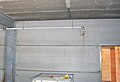 A specific water pipe made for use with pressure vessels. The pipe can sustain high pressure-water and is relatively small
-
 Concrete water pipe
-
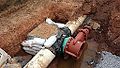 Connecting to an existing water line (white pipe) with a stainless steel tapping sleeve and valve (red). A concrete thrust block is being formed behind the new connection.


No comments:
Post a Comment